Strangr Dasht Gard
Studiio Dangg’s Strangr Dasht Gard in New Delhi thoughtfully reinterprets communal gathering through selective design, creating an introspective, poetic space that invites exploration and connection in an evolving urban landscape.
Stangr – Dasht Gard is the second outpost of the Stangr universe, a sibling to Agantuk in Greater Kailash 1. As with every version of Strangr, Dasht Gard as a space is the personification of an imagined being as well, envisioned by Mohit Yadav, Founder and Partner at Greenr and Strangr. If Agantuk, meaning the unexpected visitor, was a moment of surprise, Dasht Gard is a deeper dive inward: the madman, the wanderer, the lover, the poet. The name itself suggests a certain beautiful recklessness, a desire to meander, to feel, and to question. It is less a conventional bar and more a poetic space of assembly, one that tries, quietly and deliberately, to explore what it means to gather, to care, and to be Indian today.
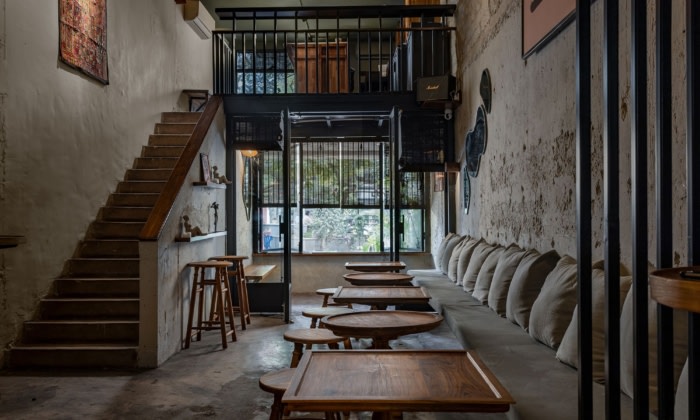
The space is located in Vasant Vihar, a neighbourhood with a mix of old-world charm and urban anonymity. When the studio inherited the site, the design of the carcass was still resonant of its previous owner. Rather than starting anew, we engaged in a process of selective subtraction, peeling back layers, listening to what the space wanted to become. The false ceilings were removed to expose volume, and the wall beside the staircase was taken down to allow light and openness to flow more freely. We sought to make more space, not only physically but also emotionally, by allowing the architecture to breathe.
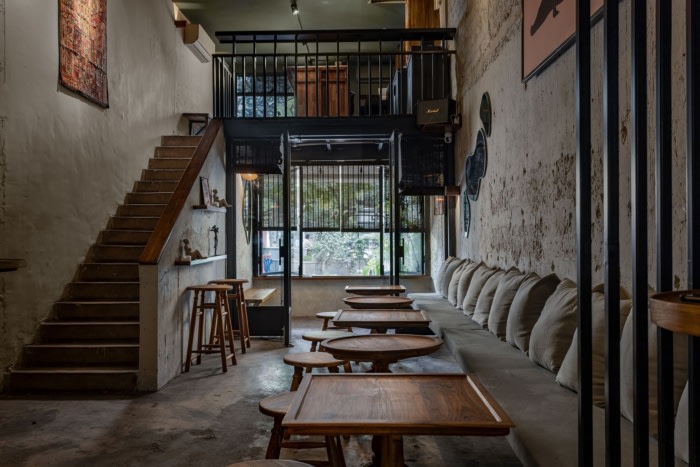
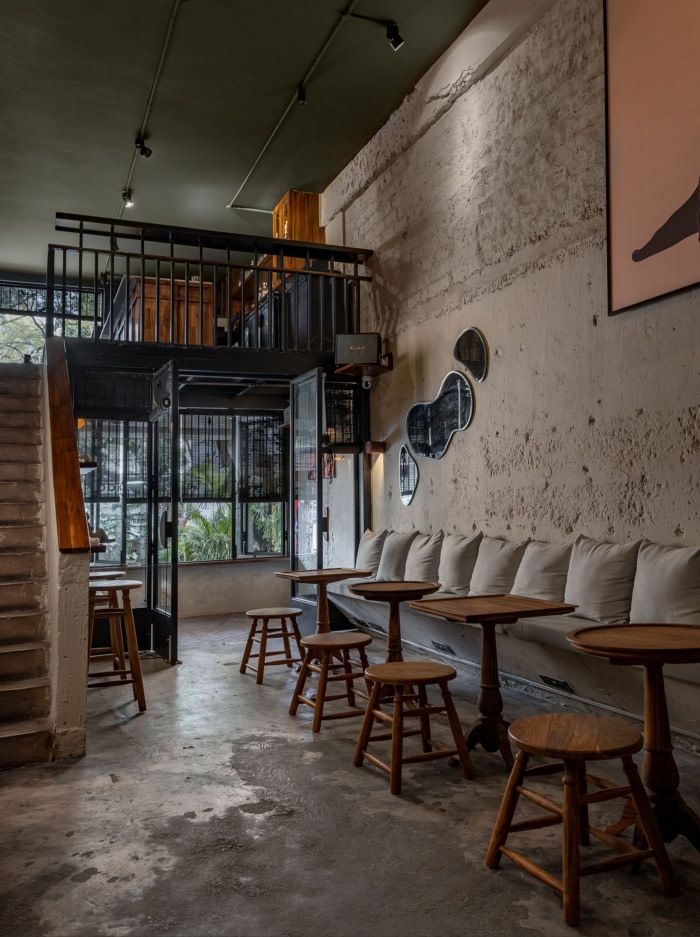
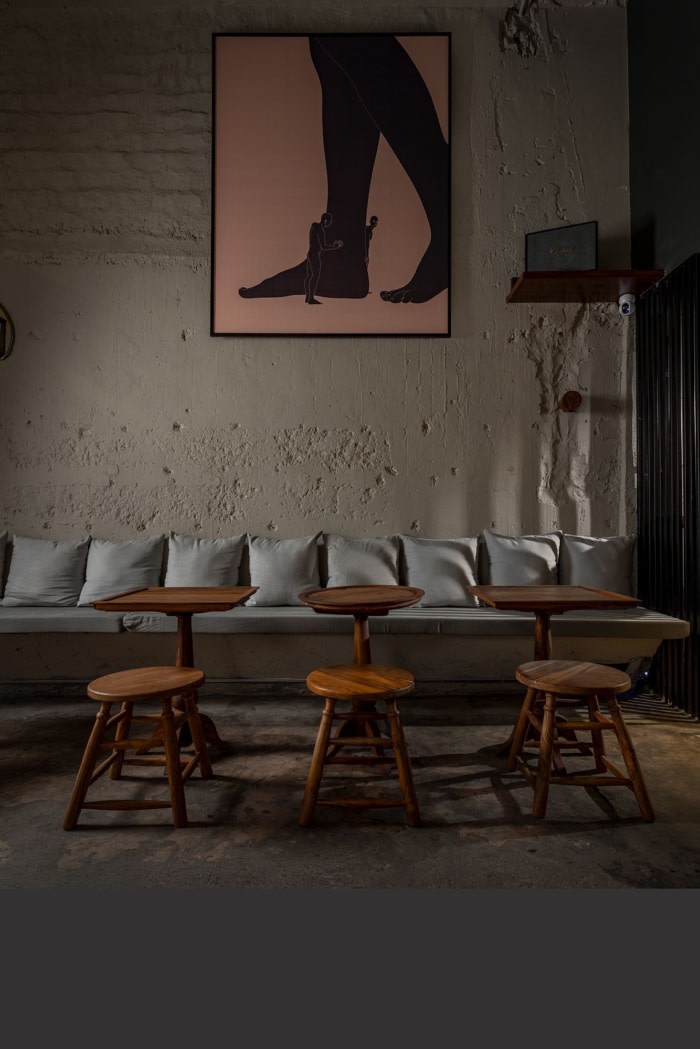
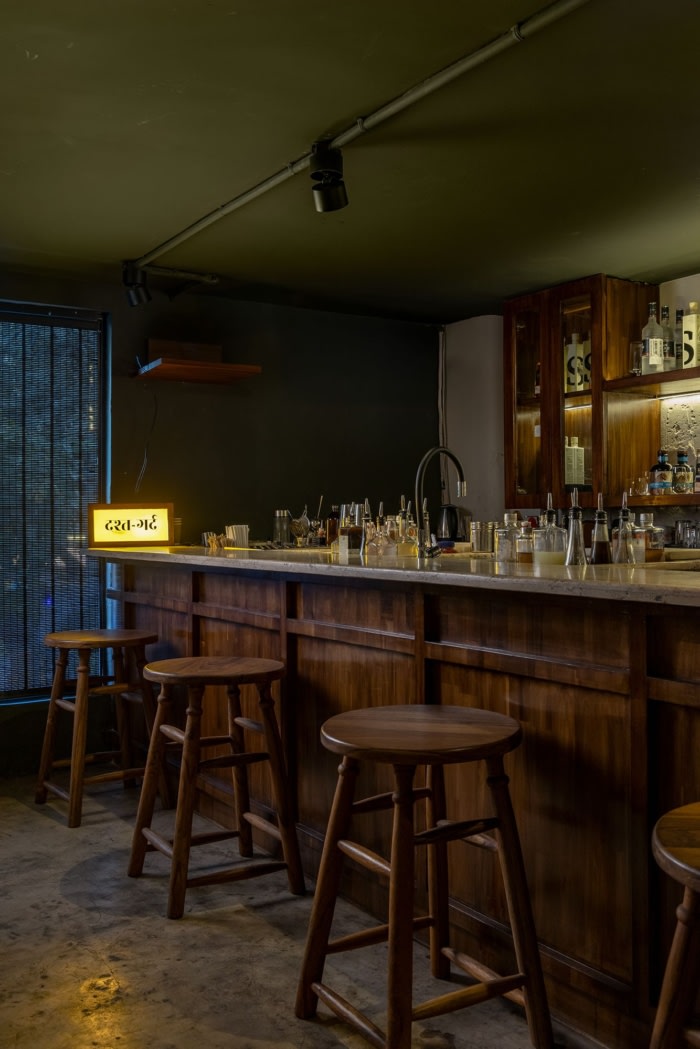
As one enters the cosy confines of Strangr Dasht Gard, they are greeted with a linear space that may seem understated at first, but boasts of varied spatial sections with their own distinct character. The interior of the lower level is held together by a critical intervention – a concrete bench that serves as a long, cast-in-place element. Like a piece of landscape, it anchors the seating area without overwhelming it. Angled so that the aged IPS flooring flows beneath it, it visually expands the space, along with serving as a datum for the individual seating clusters. The narrative of community is reinforced here, for this shared fixture serves to facilitate interaction between different sets of patrons. Situated solemnly to one side is the downstairs bar, imagined and executed as a home bar. With no front counter and a light metal ledge, it acts as both a subtle separation between the bartender and the patron, as well as a serving station. The design element that ties this modest bar to the rest of the space is the metal ledge that replicates the railing on the mezzanine level.
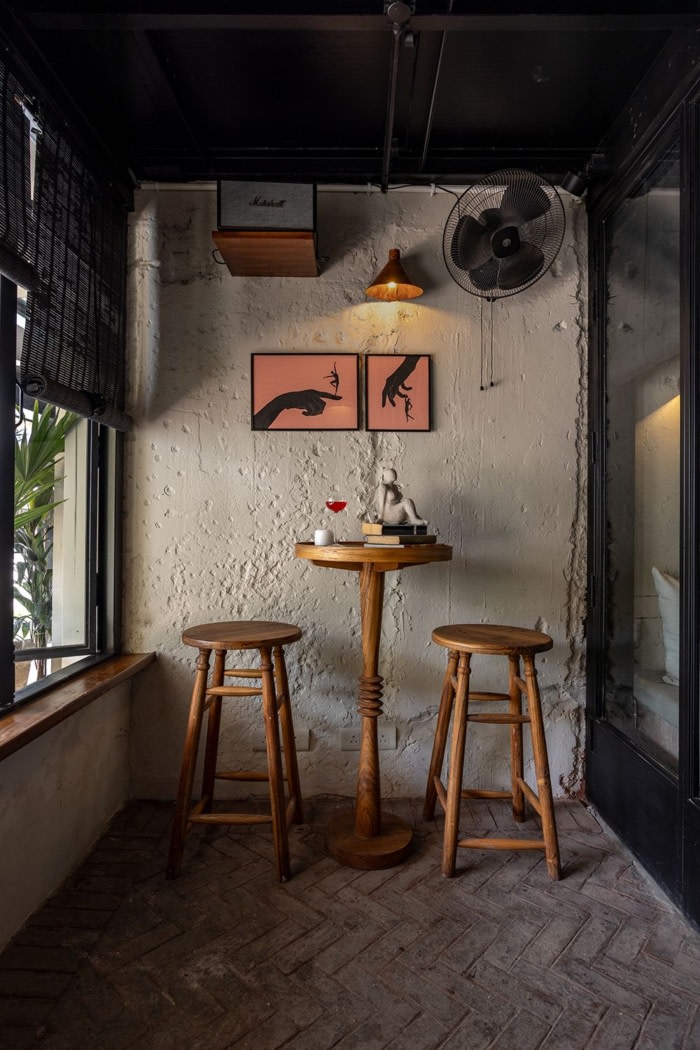
As one walks further, the outdoor area continues this tale of introspective and unintentional camaraderie. The smoking area, previously open and visible from the street, has now been closed off in the front and opened through large framed windows. The entrance too was rerouted, shifting the axis of arrival and gently reframing how one enters and inhabits the space. But most importantly, it creates a space that “looks in”, versus one that observes the outdoors. Brick inlay flooring outdoors echoes the tactile palette of Agantuk. These material decisions reflect a consistent dialogue across Stangr locations: echoes, not copies. Familiar, yet new.
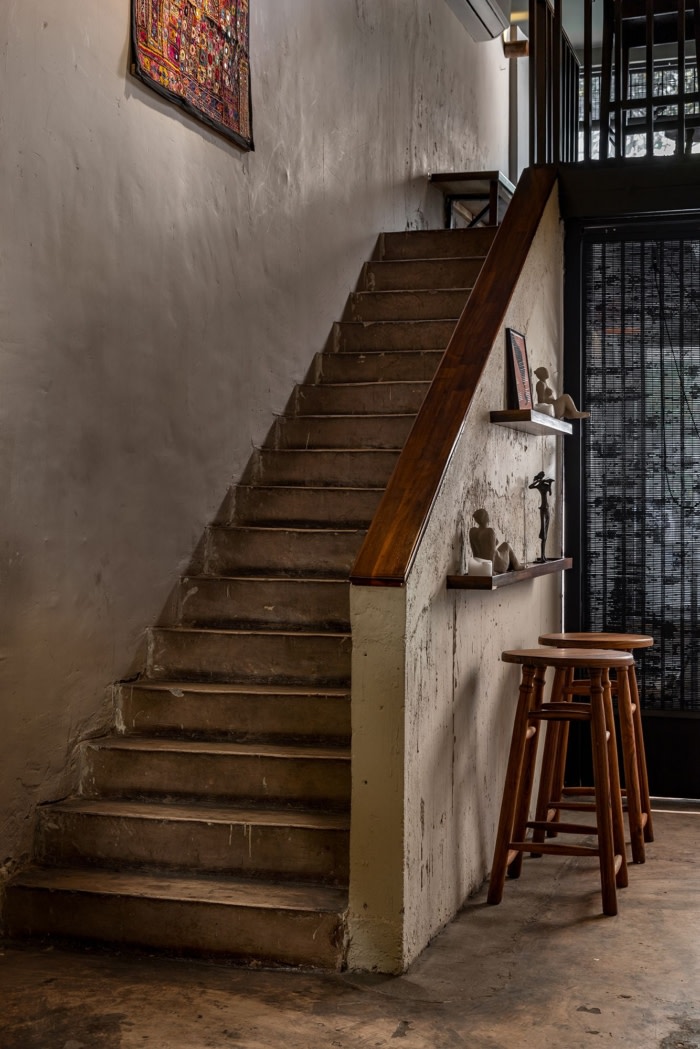
The upper level was a key intervention. With unusually high ceilings, a decision was taken to create a mezzanine level, creating a sense of loftiness without disconnect. An IPS flooring clad staircase leads one to the level above. Going beyond mere functionality, and reminiscent of Agantuk, it successfully serves as spill-out seating, and the best seat in the house for artist performances. The mezzanine hosts a bar that subtly references the visual language of Stangr Agantuk. It retains the black bar motif, the interplay of wood and metal, and the floating ledge detail that invites one to sit, perch, and pause. Designed in the style of an omakase counter, the upstairs bar creates a sense of performance and presence. It invites interaction but allows space for solitude too, a nod to the wandering poet in the name. MS detailing from the mezzanine bar ledge continues at the serving counter, creating rhythm and continuity. These details, small but intentional, help form a spatial language that is recognisably Stangr, yet specific to Dasht Gard. But unlike its sibling, it leans into a moodier, more introspective palette – green walls meeting raw whitewashed textures, smooth surfaces playing against exposed brick and rough concrete.
Texture plays a critical role throughout the design. Where once there was POP and wood cladding, we revealed what lay beneath, letting the building tell its own story. The walls speak in multiple dialects: some raw, some finished, some stained with time. We used these layers intentionally, choosing which ones to preserve and which to rework. This allowed us to maintain a sense of honesty and process, ensuring that nothing felt too precious or over-designed. Instead, we crafted a space that feels discovered rather than imposed. Warmth too, was crucial. As much as we exposed and stripped down, we also layered comfort and intimacy. Wooden furniture and floating shelves soften the industrial quality of the concrete carcass. The handrail on the staircase leading to the mezzanine has a timber finish as well, offering both tactility and visual relief.
The personification of Dasht Gard reflects in the decorative elements and styling details as well – unconventional and unrestrained. While a larger than life artwork by Nikhil Kaul graces the dominant wall, the discerning eye may also spot his creations tucked away in multiple nooks and crannies throughout the space, tying the sections together, pieces that are indigenous to Strangr. Vintage imagery from the Bhuvan Kumari Devi Archive may also be spotted throughout the space, quietly evoking curiosity.
More than a bar, Dasht Gard is a space of inquiry. It asks: what does it mean to be Indian today, not in grand gestures, but in quiet rituals of gathering? What does love look like in public space? How do we create care, not just for one another, but for the spaces we inhabit? Stangr doesn’t offer answers. Instead, it invites you to sit with the question, to stay a little longer, to feel a little deeper.
In a time when spaces are often about spectacle, Stangr Dasht Gard chooses subtlety, philosophy, and poetry. It is both a continuation and a departure, recognisable to those who know Stangr, but reconfigured in its own voice. As with all Studiio Dangg projects, it’s not just about design, it’s about meaning, mood, and memory. A place for the madman, the lover, the poet in all of us.
Design: Studiio Dangg
Design Team: Manav Dangg, Akanksha Sharma, Sinchana T, Anoushka Soni
Photography: Jeetin Sharma